

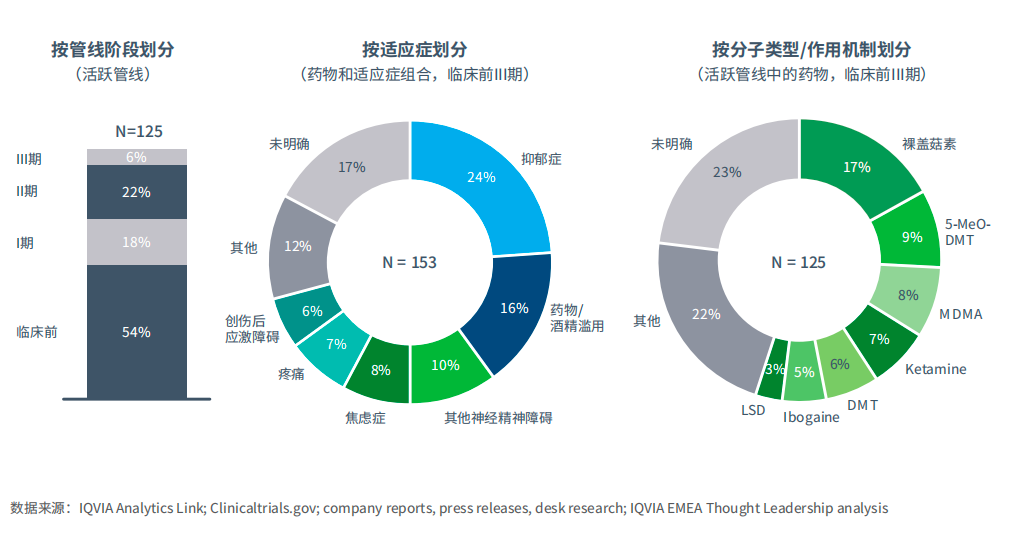
Psychedelics are psychoactive substances capable of inducing hallucinations and triggering a spectrum of cognitive and emotional alterations. Research has revealed enormous therapeutic potential of psychedelics for neuropsychiatric conditions. Globally, there are hundreds of psychedelic drug development pipelines, more than half of which remain in the preclinical stage. These programs target a wide range of central nervous system (CNS) disorders, predominantly major depressive disorder, anxiety disorders, chronic pain, post-traumatic stress disorder (PTSD), and other neuropsychiatric illnesses.
Target Differences Between Classic and Non-Classic Psychedelics
Psychedelics are categorized into classic and non-classic subtypes. Classic psychedelics mainly include psilocybin, lysergic acid diethylamide (LSD), and mescaline. They modulate brain function and neuroplasticity primarily by acting on receptors such as 5-HT2A and 5-HT1A.
Non-classic psychedelics exert pharmacological effects through alternative pathways rather than the 5-HT2A receptor. As an NMDA receptor antagonist, ketamine works via this mechanism; 3,4-methylenedioxymethamphetamine (MDMA) facilitates the release of dopamine and serotonin; ibogaine activates κ-opioid receptors. Through their unique receptor or transporter targets, non-classic psychedelics ultimately regulate synaptic plasticity and related neural circuit functions, ameliorating emotional and perceptual abnormalities.
Mounting evidence indicates that psychedelics can modulate emotional dysregulation and treat psychiatric diseases.
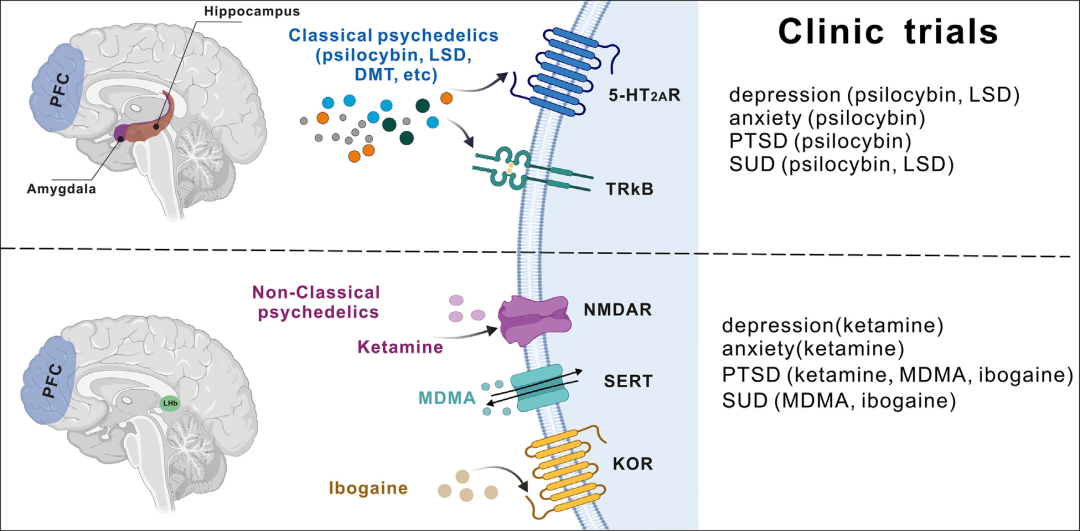
Targeted Brain Regions, Molecular Targets and Clinical Effects of Various Psychedelics
From Hallucinogenic Substances to Therapeutic Agents: Clinical Exploration of Psychedelics
Despite divergent mechanisms of action and long-term stringent regulatory controls, multiple clinical trials have validated the therapeutic value of psychedelics for various brain disorders, most notably depression. Multiple drug candidates have entered clinical development, with COMP360 developed by Compass Pathways advancing the furthest into Phase III clinical trials. Therapeutic benefits have also been demonstrated for pain management, substance use disorders, and PTSD.
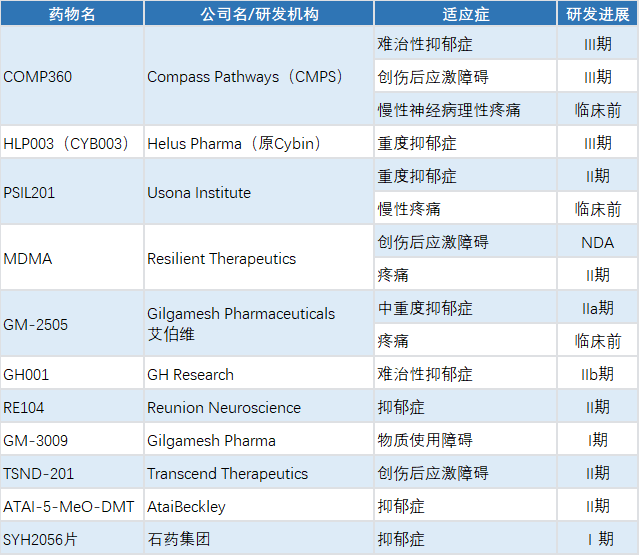
Selected Psychedelic Drug Candidates in Development and Their Development Stages
Preserving Therapeutic Efficacy While Eliminating Hallucinogenic Side Effects
然而,这些临床效果背后,致幻、感知扭曲、情绪过山车等严重不良反应,让许多制药巨头在Ⅱ/Ⅲ期折戟沉沙。“能不能保留疗效,丢掉幻觉?”这成了药物化学家的终极挑战。Nevertheless, severe adverse reactions including hallucinations, perceptual distortion, and extreme emotional lability have caused many pharmaceutical giants to terminate their programs in Phase II and Phase III trials. Identifying strategies to retain therapeutic efficacy while eliminating hallucinogenic effects has become an ultimate challenge for medicinal chemists.
Starting from 2020, researchers have attempted small-molecule structural modification to selectively activate antidepressant-related signaling pathways without triggering hallucinations. A representative example is SYH2056 tablet developed by China’s CSPC Pharmaceutical Group, a precisely targeted 5-HT2A receptor modulator. It delivers rapid therapeutic onset after single administration with no hallucinogenic effects observed. Preclinical studies further demonstrate that this compound promotes neurite outgrowth of dendrites and dendritic spines, enabling neural network remodeling in the brain. By the end of 2025, this drug has obtained clinical trial approvals in both China and the United States.
Preclinical Screening Strategies for Hallucination Risk Assessment
Psychedelic therapeutics hold promising prospects; eliminating hallucinogenic side effects would render these agents both safe and potent for clinical application. Accordingly, screening candidate compounds free of hallucinogenic risk at cellular and animal study stages is critically important. Major screening approaches are outlined below:
• Cellular-level screening: High-throughput profiling of 5-HT2A receptor activation patterns, including G protein and β-arrestin signaling bias, to preliminarily predict hallucinogenic liability.
• Animal behavioral assays: Known psychedelics elicit rapid, transient head-twitch responses (HTR) in mice and rats. The canonical HTR paradigm is utilized to predict hallucination risk in humans.
• Neuroimaging analysis: In vivo PET or fMRI imaging in laboratory animals to detect aberrant activation of the default mode network (DMN) induced by test compounds.
Psychedelic drug development is standing at an inspiring inflection point: researchers leverage the remarkable therapeutic benefits inherent to traditional psychedelic molecules while deploying modern scientific methodologies to mitigate severe adverse effects such as hallucinations.
Kylin Lab specializes in preclinical CRO services for CNS drug discovery, covering indications including depression, anxiety disorders, and substance use disorders. Our capabilities span cellular-level signaling pathway screening, alongside a multi-dimensional pharmacodynamic evaluation system incorporating behavioral assessment, biomarker detection, electrophysiology, and other testing modalities. We deliver end-to-end, highly customized integrated technical solutions for CNS drug development, effectively improving the clinical translation rate of candidate therapeutics.

References:
Kylin Lab
CNSxplore | Pioneering CNS Drug Discovery--In vitro and in vivo, Beyond limits
Kylin Lab is a preclinical CRO company specializing in central nervous system (CNS) diseases, dedicated to offering one stop solutions for CNS drug discovery. With a portfolio of fully-validated cellular and animal disease models, combined with comprehensive research and analytical capabilities, we empower clients to accelerate the development of innovative therapies and reduce clinical trial risks.
Kylin Lab boasts an experienced technical team well-versed in international regulations, along with high-standard experimental platforms. Our core technologies include AI-driven phenotypic screening, humanized stem cells and organoids, electrophysiology, high-throughput electroencephalography (EEG), histology, and molecular biology. Our expertise spans a broad range of areas including Alzheimer’s disease, Parkinson’s disease, depression, schizophrenia, spinal muscular atrophy (SMA), pain, and stroke etc.
Since its establishment, Kylin Lab has adhered to the philosophy of “Pioneering R&D, Leading in technology Quality-first, Customer-centric.” We have served hundreds of clients, successfully completed numerous thematic research projects and IND submissions, and established a high-quality, stable, and forward-looking efficacy evaluation system.