Bipolar disorder (BD) is characterized by alternating episodes of mania/hypomania and depression, featuring a narrow therapeutic window and high relapse rate. Most existing therapeutic agents were discovered serendipitously, while rationally designed drugs targeting the pathological mechanisms of bipolar disorder remain very limited. This accounts for the clinical challenges and drives new drug discovery for BD to shift from “serendipitous discovery” toward “rational design”.
Clinical Medications for Bipolar Disorder
Current treatment of bipolar disorder mainly relies on mood stabilizers and atypical antipsychotics.

Overall, most agents are not developed against BD pathological mechanisms, associated with frequent adverse reactions, common drug-drug interactions and poor patient adherence.

Accelerating Progress in Drug Development
Constrained by multiple limitations of available clinical therapies, BD new drug research continuously explores novel targets, innovative administration routes and cutting-edge therapeutic strategies.
Classic Dopamine Receptor Targets
Lumateperone (Caplyta) from Johnson & Johnson is a 5-HT₂A receptor antagonist and dopamine receptor phosphoprotein modulator that concurrently regulates serotonin, dopamine and glutamate pathways. It has received FDA approval for depressive episodes associated with bipolar I or II disorder, for monotherapy or combination with lithium/valproate. In September 2026, its Phase III trial for manic episodes of bipolar I disorder met the primary endpoint.
HS-10380 from Hansoh Pharmaceutical has obtained clinical trial approval for manic episodes of bipolar I disorder, in addition to schizophrenia. As a D2/D3/5-HT₁A multi-target agonist with potent 5-HT₂A antagonism, it exhibits favorable receptor binding profiles and in-vivo pharmacodynamic effects in animal models in preclinical studies.
ABBV-932, co-developed by AbbVie and Gerui Pharmaceutical, is a selective D3 dopamine receptor modulator with DRD2 modulating activity. It has been approved for clinical trials in China for BD depressive episodes.
Promising Direction: TAAR1 Agonists
The TAAR1 gene is located at 6q23.2 and linked to susceptibility to schizophrenia and BD. Its functions in regulating neural plasticity, adult neurogenesis and dopamine/serotonin signaling form the theoretical basis for BD treatment.
LY03020 from Luye Pharma is the world’s first TAAR1/5-HT₂CR dual-target agonist with BD among its target indications. The first patient enrollment for its Phase II clinical trial in China has been completed.
Formulation Optimization to Improve Treatment Adherence
Uzedy (long-acting subcutaneous risperidone) by Teva Pharmaceuticals has been approved for maintenance treatment of BD-I, usable as monotherapy or combined with lithium/valproate. Its sustained-release technology effectively addresses adherence challenges for long-term maintenance therapy.
A joint research by the Catholic University of the Sacred Heart in Rome and the University of Salerno developed lithium-loaded gold nanoparticle nasal spray, which directly delivers lithium to the brain. In animal models, it achieves therapeutic effects comparable to oral lithium at lower lithium ion concentrations, with potential to reduce systemic adverse reactions. Its mechanism is related to inhibition of hippocampal GSK‑3β activity.
These novel targets raise higher requirements for preclinical pharmacodynamic evaluation: manic-like and depressive-like behavioral phenotypes need to be assessed simultaneously.

Addressing Cyclical Switching of BD in Preclinical Stage
The core feature of BD is cyclic switching among mania, depression and euthymia, yet existing animal models can almost only recapitulate unidirectional phenotypes. The industry evaluates models primarily from three validity dimensions:
• Face validity: the extent to which behavioral phenotypes mimic clinical features of the disease.
• Predictive validity: pathological phenotypes can be effectively reversed by therapeutic drugs.
• Construct validity: recapitulation of disease-related etiology and molecular pathological mechanisms. This dimension remains the hardest to achieve as the etiology of BD has not been fully elucidated.
In recent years, strategies for BD pharmacodynamic evaluation have gradually shifted toward constructing multi-dimensional evidence packages. In July 2024, HS-10380 obtained clinical approval for manic episodes of bipolar I disorder; the supporting data for its application came from a three-dimensional package consisting of “receptor binding data + plasma exposure data + in-vivo pharmacodynamics in animal models”.
Positive control drugs are used to verify the predictive validity of models, combined with data of exposure level, target occupancy and downstream mechanism biomarkers. Classic mania models serve as core evidence for behavioral pharmacodynamics to build a complete chain of evidence. This evidence framework of “mechanism + exposure + behavioral endpoints” is becoming a reference paradigm for BD preclinical evaluation.

Kylin Lab’s Capabilities in BD Model Establishment and Detection
Kylin Lab performs bipolar disorder model construction and post-dosing pharmacodynamic assessment, providing supportive pharmacodynamic evidence for preclinical evaluation of BD drug candidates. Customized evaluation protocols for manic-like, depressive-like or combined bipolar pharmacodynamics can be developed according to the target mechanism of candidate compounds.
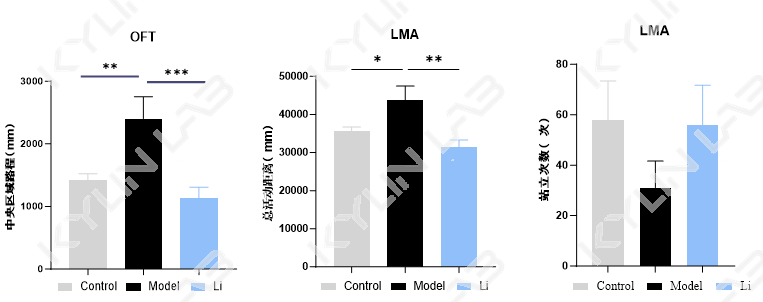
Results from the OFT and LMA tests show that mice in the model group displayed markedly increased total travel distance, presenting manic-like behaviors consistent with experimental expectations, while rearing frequency showed a declining trend. The total travel distance of mice in the lithium carbonate group was significantly lower than that of the model group.
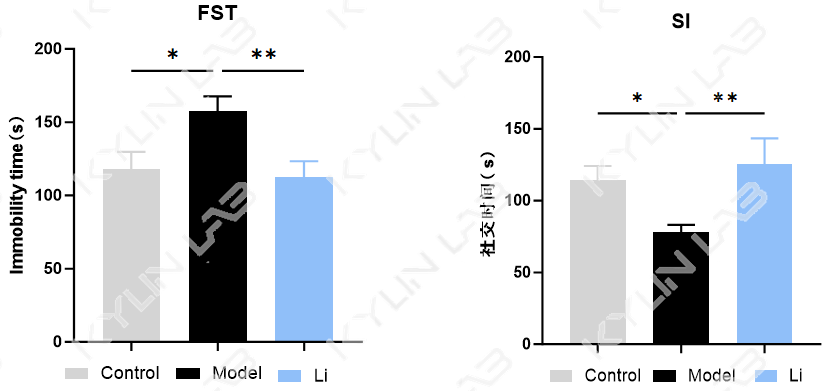
Data from forced swim test and social interaction test demonstrated obvious depressive-like behaviors and social avoidance in model mice. Lithium ions effectively alleviated these behavioral abnormalities.

Source:
Wataru Ota, Tomomi Yamanoue, Akane Sano, et al.95. Reverse Translational Manipulation of Cerebellar Synaptic Output Reproduces Bipolar Manic and Depressive-Like Behaviors in Mice,Biological Psychiatry,Volume 99, Issue 10, Supplement,2026,Page S140,ISSN 0006-3223
Chaves‐Filho A, Eyres C, Blöbaum L, Landwehr A, Tremblay M. The emerging neuroimmune hypothesis of bipolar disorder: An updated overview of neuroimmune and microglial findings Journal of Neurochemistry. 2024;168(9):1780-1816. doi:10.1111/jnc.16098
PatSnap Database
KylinLab
CNSxplore | Pioneering CNS Drug Discovery--In vitro and in vivo, Beyond limits
Kylin Lab is a preclinical CRO company specializing in central nervous system (CNS) diseases, dedicated to offering one stop solutions for CNS drug discovery. With a portfolio of fully-validated cellular and animal disease models, combined with comprehensive research and analytical capabilities, we empower clients to accelerate the development of innovative therapies and reduce clinical trial risks.
Kylin Lab boasts an experienced technical team well-versed in international regulations, along with high-standard experimental platforms. Our core technologies include AI-driven phenotypic screening, humanized stem cells and organoids, electrophysiology, high-throughput electroencephalography (EEG), histology, and molecular biology. Our expertise spans a broad range of areas including Alzheimer’s disease, Parkinson’s disease, depression, schizophrenia, spinal muscular atrophy (SMA), pain, and stroke etc.
Since its establishment, Kylin Lab has adhered to the philosophy of “Pioneering R&D, Leading in technology Quality-first, Customer-centric.” We have served hundreds of clients, successfully completed numerous thematic research projects and IND submissions, and established a high-quality, stable, and forward-looking efficacy evaluation system.