

Recent drug development for schizophrenia has encountered two successive setbacks: Alto Neuroscience’s ALTO-101 failed to meet the primary endpoint in Phase II trials for cognitive impairment treatment; a patient death occurred in Newron’s evenamide Phase III trial. Though the event was assessed to be unrelated to the drug, the FDA still suspended the trial. Such incidents are commonplace in psychiatric drug R&D. Nevertheless, the huge unmet clinical needs and vast market potential continue to drive progress across the industry.
New Breakthrough Directions for Schizophrenia Treatment
Looking back at nearly 70 years of treatment history, almost all schizophrenia drugs follow the same mechanism — blocking the dopamine D2 receptor. This approach can alleviate positive symptoms such as hallucinations and delusions, yet yields limited effects on negative symptoms including social withdrawal and anhedonia, as well as cognitive impairment. While many patients no longer experience acute psychotic episodes, they remain in a state of severe long-term functional impairment with little improvement in quality of life.
The root cause lies in the fact that schizophrenia is not a single-etiology disease, and a single drug is unlikely to effectively address all its symptoms.
Current research has revealed reduced synaptic connections, decreased dendritic spine density, and impaired function of inhibitory GABAergic neurons in the cerebral cortex of patients. More than 200 relevant risk gene loci have been identified, most involved in synaptic structure, neural development or myelination. Genes related to the glutamatergic system are far more enriched than those of the dopaminergic system. In-depth insights into disease mechanisms are bringing new turning points for schizophrenia treatment.
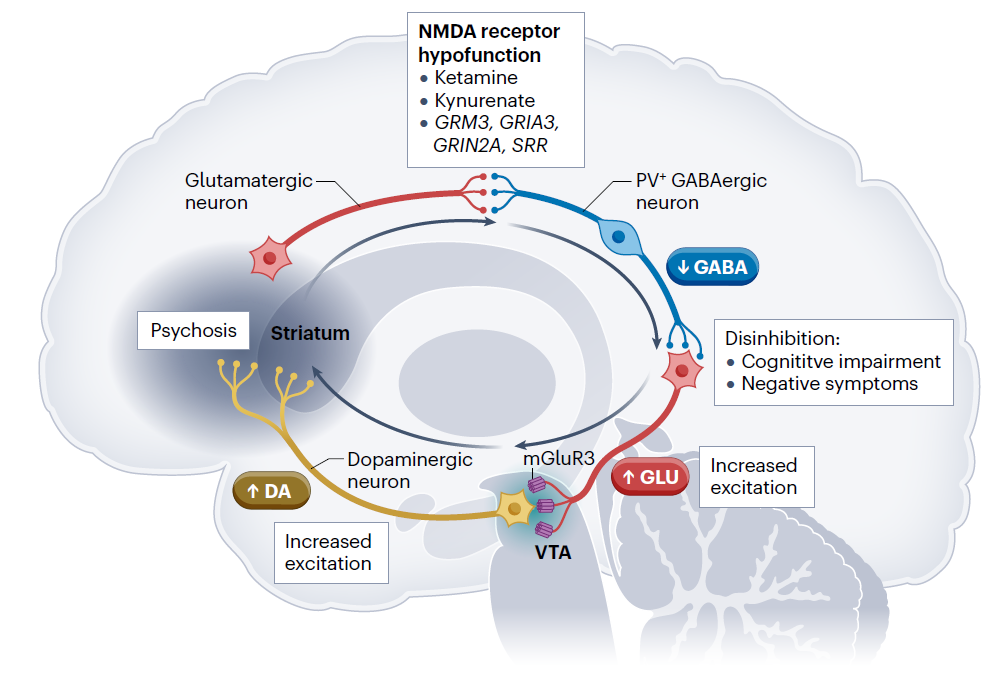
Brain circuit connecting cortical neuropathology to subcortical dopaminergic dysfunction in schizophrenia
Focus on the Glutamatergic Signaling Pathway
Glutamate is the brain’s primary excitatory neurotransmitter, participating in approximately 80% of corticolimbic synaptic activities. Studies have confirmed that insufficient NMDAR (N-methyl-D-aspartate receptor) function is one of the core pathological mechanisms of the disease. Multiple therapeutic strategies targeting this target are advancing rapidly:
GlyT1 inhibition: Elevates glycine concentration in the synaptic cleft to enhance NMDAR signaling. Representative drug: Boehringer Ingelheim’s iclepertin (BI425809), now in Phase III clinical trials for schizophrenia-related cognitive impairment.
KATII inhibition: Reduces the production of kynurenine, an endogenous NMDAR antagonist. For instance, Kynexis’s KYN-5356 is in Phase II clinical development.
Other strategies: Modulating neuronal excitability, reducing abnormal glutamate release, or promoting synaptic regeneration and neural network remodeling.
These attempts go beyond mere symptom control, aiming to restore the brain’s excitatory signaling imbalance and offer genuine hope for improving cognitive and negative symptoms.
Cholinergic Signaling Pathway: Breakthrough in Novel Mechanisms
Beyond the glutamatergic pathway, the cholinergic signaling pathway opens another avenue for schizophrenia treatment. Among them, mAChR (muscarinic acetylcholine receptor) agents have demonstrated promising antipsychotic activity, especially drugs targeting M1/M4 mAChRs, which are expected to treat core schizophrenia symptoms.
KarXT, jointly developed by BMS and Zai Lab, is a combined M1/M4 mAChR agonist and antagonist. It can improve both positive and negative symptoms while avoiding partial risks associated with traditional drugs. Approved by the FDA in September 2024 and launched in China in December 2025, KarXT is the first novel antipsychotic drug in decades independent of the dopamine D2 receptor mechanism.
Maplight’s ML-007C-MA, an M1/M4 mAChR agonist/antagonist combination drug, has entered Phase II clinical trials. Kylin Lad supports NeuShen Pharma in the clinical translation of NS-136, the first novel selective M4 mAChR positive allosteric modulator in China, which has advanced to Phase II clinical trials. Multiple related studies have advanced to clinical stages, proving that R&D of neuropsychiatric drugs targeting muscarinic receptors has become a booming industry trend.Related reading: Decoding Muscarinic Receptors to Drive R&D of Novel Neuropsychiatric Drugs
Parallel Progress of Other Emerging Targets
Neuroplasticity: sGC (soluble guanylate cyclase) stimulators and PDE9 (phosphodiesterase 9) enhancers enhance synaptic plasticity by elevating intracellular cGMP levels to improve cognitive symptoms.
TAAR1 Agonists: TAAR1 (Trace Amine-Associated Receptor 1) is one of the most high-profile targets. Otsuka Pharmaceutical’s ulotaront (SEP-363856) has entered Phase III trials and can improve both positive and negative symptoms without blocking D2 receptors.
Inflammation and Metabolism: Inflammatory responses, oxidative stress and metabolic abnormalities have gradually become research hotspots. Adjunctive therapies in these areas help improve patients’ overall health and reduce comorbidity risks.
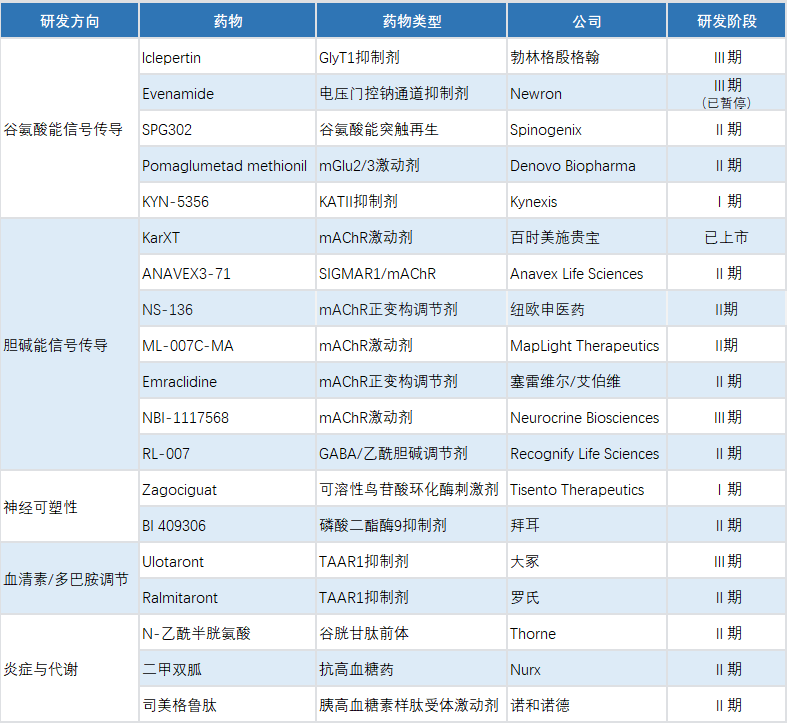
Selected investigational drugs for schizophrenia
The R&D of schizophrenia drugs is a long-term exploration. With further clarification of pathological mechanisms, multiple pathways including glutamatergic, cholinergic and TAAR1 are advancing in tandem. More innovative drugs are expected to emerge in the future to fill unmet treatment gaps.
Kylin Lab Empowers R&D of Schizophrenia-Related Drugs
Kylin Lad focuses on providing preclinical CRO services for CNS drug research and development, and has established a comprehensive CNS drug research platform. The company has participated in numerous preclinical R&D projects for schizophrenia drugs and accumulated extensive industry experience. It owns a full spectrum of fully validated disease models, including various chemical-induced schizophrenia-like animal models that can simulate core clinical manifestations of schizophrenia such as positive symptoms, negative symptoms and cognitive impairment. It has also built a multi-dimensional drug efficacy evaluation system covering behavioral assessment, biomarker detection, electrophysiology and other approaches. Kylin Lad can provide full-process, highly adaptive integrated technical solutions for schizophrenia drug development, effectively improving the clinical translation rate of candidate drugs.

Reference:
Joseph T. Coyle, Steven M. Paul.Novel drug treatments for schizophrenia. Nature Reviews Drug Discovery volume 25, pages310–330 (2026)
https://mp.weixin.qq.com/s/D9BPx1N1hnm7j6RNjC-Cjw?scene=1
https://mp.weixin.qq.com/s/gxXF4NGvYa5jhAefrhFiJA?scene=1
Kylin Lab
CNSxplore | Pioneering CNS Drug Discovery--In vitro and in vivo, Beyond limits
Kylin Lab is a preclinical CRO company specializing in central nervous system (CNS) diseases, dedicated to offering one stop solutions for CNS drug discovery. With a portfolio of fully-validated cellular and animal disease models, combined with comprehensive research and analytical capabilities, we empower clients to accelerate the development of innovative therapies and reduce clinical trial risks.
Kylin Lab boasts an experienced technical team well-versed in international regulations, along with high-standard experimental platforms. Our core technologies include AI-driven phenotypic screening, humanized stem cells and organoids, electrophysiology, high-throughput electroencephalography (EEG), histology, and molecular biology. Our expertise spans a broad range of areas including Alzheimer’s disease, Parkinson’s disease, depression, schizophrenia, spinal muscular atrophy (SMA), pain, and stroke etc.
Since its establishment, Kylin Lab has adhered to the philosophy of “Pioneering R&D, Leading in technology Quality-first, Customer-centric.” We have served hundreds of clients, successfully completed numerous thematic research projects and IND submissions, and established a high-quality, stable, and forward-looking efficacy evaluation system.